
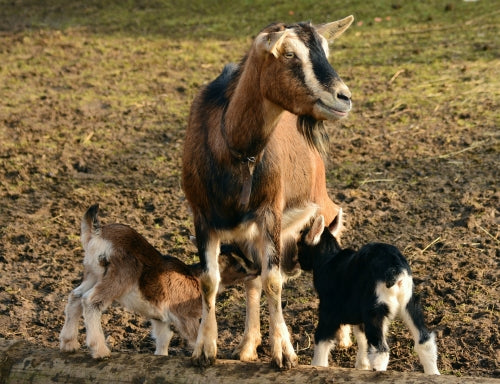
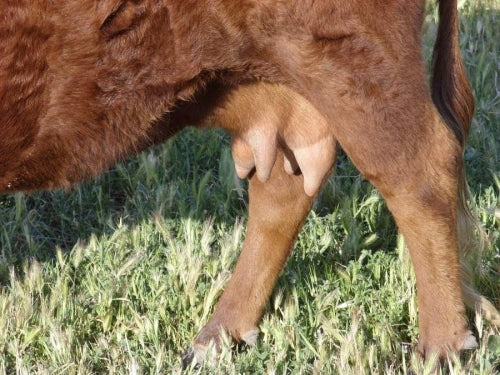
Supernumerary, or extra teats in ruminants are defined as any teat that is in excess of the normal number of teats. Having five or six teats is not normal in a cow, but not uncommon. Which ones are extra? Usually, it is very obvious; sometimes it is helpful to look at the placement, size, and sphincter development of all of the teats to determine the necessary ones verses the extra ones. Most of the extra teats in cattle are blind, and do not have a streak canal or attachment to mammary tissue. A blind teat is not capable of producing milk. Blind teats are often found in pairs. It is not uncommon in cattle to find a pair of “button-like” projections on the rear quarters, or a couple of lesser developed dangly teats next to the good ones. Causing little more than an unsightly rear udder view, blind teats in a commercial beef or goat herd are not typically a problem.
Animal Health Information

Strawberry Milk
Heritage Animal Health
Blood in the Milk at Calving I milked out cow #612 this morning after she delivered her calf yesterday. Her calf was born on a beautiful spring day in an open green pasture, but failed to adjust to the nursing way of life. The cow was more than happy to let the calf nurse, but sometimes, the newborn does not instinctively start enjoying the free milk buffet. I tube fed colostrum last night and today, his vigor is decent, but his belly is empty and her udder is full. I wish I did not have to intervene and that he would suddenly have the desire to nurse from his dam, but it is time to run the cow into a chute.

Nursing Difficulties in Calves
Heritage Animal Health
A perfect day of calving is flooded with sunshine. A perfect day of calving is having a super clean and dry place ready for a calm momma cow to lay down and push her calf out like it is her job, because it is her job! A perfect day of calving is watching a cow mother-up without question by claiming and aggressively cleaning her calf. A perfect day of calving is enjoying a vigorous calf that jumps up and nurses with plenty of great quality colostrum, followed with playfully bucking, kicking and farting during the first 48 hours of life. Well, maybe not the farting.
Carrot Teats in Cows
Heritage Animal Health
Normally, a cow’s teats are cylindrical and maintain a constant diameter from top to bottom. A calf can easily slip a normal teat into its mouth from any angle. A carrot teat is an abnormal teat that is larger at the base and conically narrows towards the teat end, or sphincter. This carrot shape is due to the breakdown of the elasticity of the teat. One or two teats may be affected, or all four. As a cow nears the end of gestation and each quarter fills with colostrum, the pressure of the early milk begins to stretch out the shape of the teat. At the time of calving, a carrot teat is often very full and very turgid. Many calves cannot get their mouths wrapped around a carrot teat and are in danger of not getting enough milk and acquiring failure of passive transfer (FPT).